 KSCRS

Search
- Page Path
- HOME > Search
Original Articles
- Effect of lubricant eye drops administered before visual field testing in patients with glaucoma and dry eye
- Jiyoung Emily Lee, Eun Chul Kim
- Insights Cataract Refract Surg 2026;11(3):91-97. Published online October 29, 2026
- DOI: https://doi.org/10.63375/icrs.26.009
-
 Abstract
 PDF
 ePub
- Purpose
This study aimed to evaluate the effect of administering lubricant eye drops before visual field testing in patients with glaucoma and dry eye syndrome.
Methods
The records of 30 patients (60 eyes) with dry eye syndrome were retrospectively reviewed. Before visual field testing, 0.1% hyaluronic acid eye drops were administered to the right eye, while the left eye received no drops. The efficacy of the lubricant eye drops was assessed by retrospectively comparing tear meniscus height, noninvasive tear film break-up time (NiBUT), and corneal staining scores before and after testing.
Results
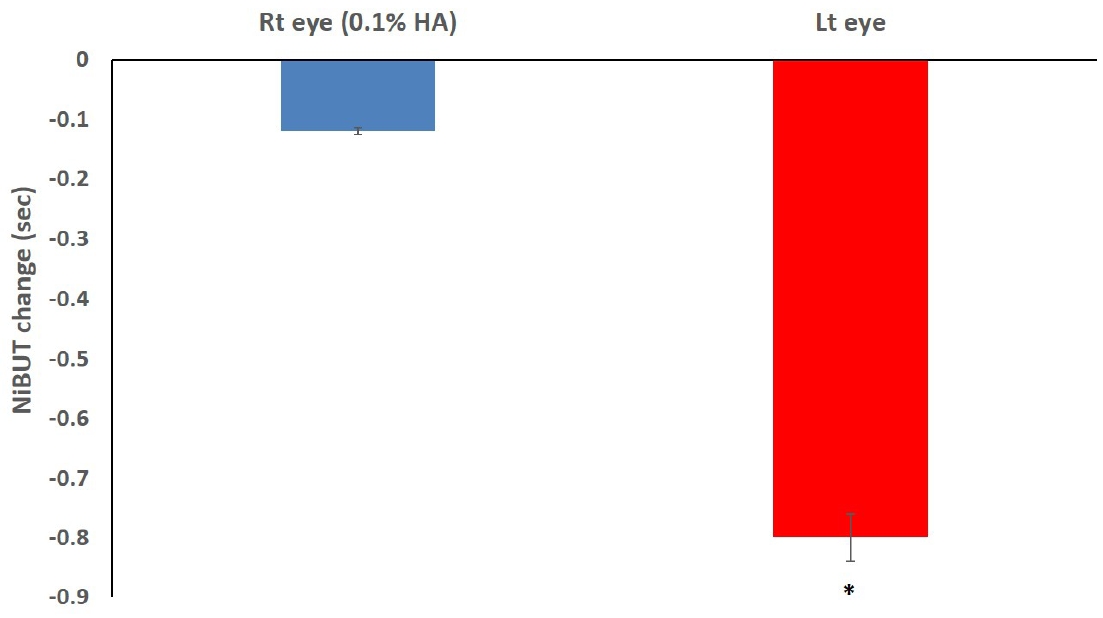
Before visual field testing, NiBUT was 5.16±2.19 seconds in the right eye and 5.07±1.98 seconds in the left eye; after testing, it was 5.04±2.36 seconds and 4.27±1.32 seconds, respectively. Tear meniscus height was 0.26±0.11 mm in the right eye and 0.25±0.10 mm in the left eye before testing, decreasing to 0.25±0.11 mm and 0.22±0.10 mm, respectively, afterward. Before testing, corneal staining scores were 1.07±0.74 in the right eye and 1.17±0.86 in the left eye; after testing, they were 1.33±0.76 and 1.90±0.95, respectively. The decreases in NiBUT and tear meniscus height from before to after testing were greater in the left eye than in the right eye, and corneal staining increased significantly (P<0.05). Fixation loss, false-positive, and false-negative rates during visual field testing were all significantly higher in the left eye than in the right eye (P<0.05).
Conclusion
Visual field testing requires patients to keep their eyes open and maintain focus for an extended period, which can exacerbate symptoms in patients with dry eye syndrome and potentially compromise test accuracy. Administering lubricant eye drops before testing, following consultation with an ophthalmologist, is thought to alleviate dry eye symptoms and improve test accuracy.
- 241 View
- 2 Download

- The effect of 2% rebamipide ophthalmic solution on early dry eye after SMILE surgery: a retrospective study
- Jin Hyoung Kim, Mu Yan Kim, Young A Kwon, Sung Wook Park, Sung Won Byun, Seong Woo Lee, Sung Hyup Lim
- Insights Cataract Refract Surg 2025;10(3):91-102. Published online October 31, 2025
- DOI: https://doi.org/10.63375/icrs.25.013
-
Abstract
PDFePub
- Purpose
The aim of this study was to investigate the effect of rebamipide 2% ophthalmic solution on early dry eye following small incision lenticule extraction (SMILE) surgery by analyzing dry eye indicators before and after the procedure.
Methods
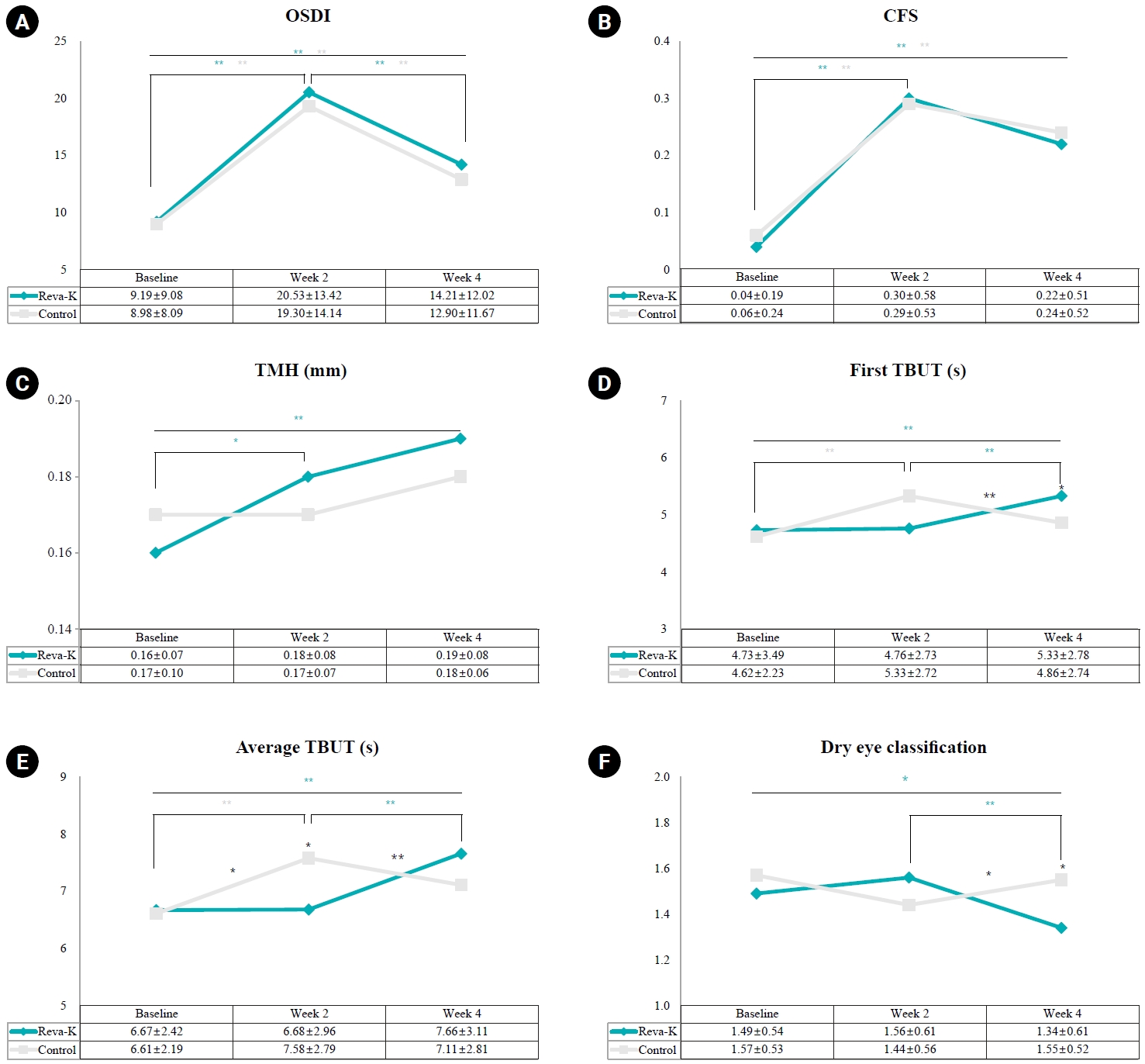
In this retrospective study, an initial sample of 372 SMILE surgery patients were divided into a rebamipide group (artificial tears and 2% rebamipide) and a control group (artificial tears only). Changes in dry eye indicators, including the Ocular Surface Disease Index (OSDI), corneal fluorescein staining (CFS) score, tear meniscus height (TMH), tear break-up time (TBUT), and dry eye classification, were analyzed at 2 and 4 weeks postoperatively in comparison with the preoperative baseline.
Results
In total, 250 patients (250 eyes) were selected: 135 in the rebamipide group and 115 in the control group. Preoperative characteristics such as gender, age, spherical equivalent refraction, ablation depth, and optical zone size showed no significant differences between the two groups. Both groups demonstrated a significant increase in OSDI and CFS scores at 2 weeks postoperatively, followed by a decrease at 4 weeks, with no significant differences between groups. TMH increased significantly in the rebamipide group at 2 and 4 weeks (P=0.043, P=0.004), but showed no significant change in control group or intergroup difference. No significant difference was found in the first TBUT between the two groups at any time point, but the average TBUT significantly and rapidly increased from 2 to 4 weeks postoperatively in the rebamipide group (P=0.001). The dry eye classification was significantly lower in the rebamipide group at 4 weeks postoperatively (P=0.014).
Conclusion
The use of rebamipide 2% ophthalmic solution immediately after SMILE surgery is expected to be helpful in treating early postoperative dry eye, as it increased TMH and TBUT starting from 2 weeks postoperatively.
- 3,554 View
- 14 Download
 First
 Prev



