
 KSCRS
KSCRS
Current issue
- Page Path
- HOME > Browse articles > Current issue
- Volume 11(2); June 2026
-


Review Article
- Glaucoma evaluation and management in refractive surgery candidates: a review
- Yeoun Sook Chun
- Insights Cataract Refract Surg 2026;11(2):27-39. Published online June 18, 2026
- DOI: https://doi.org/10.63375/icrs.26.002
-
 Abstract
 PDF
PDF ePub
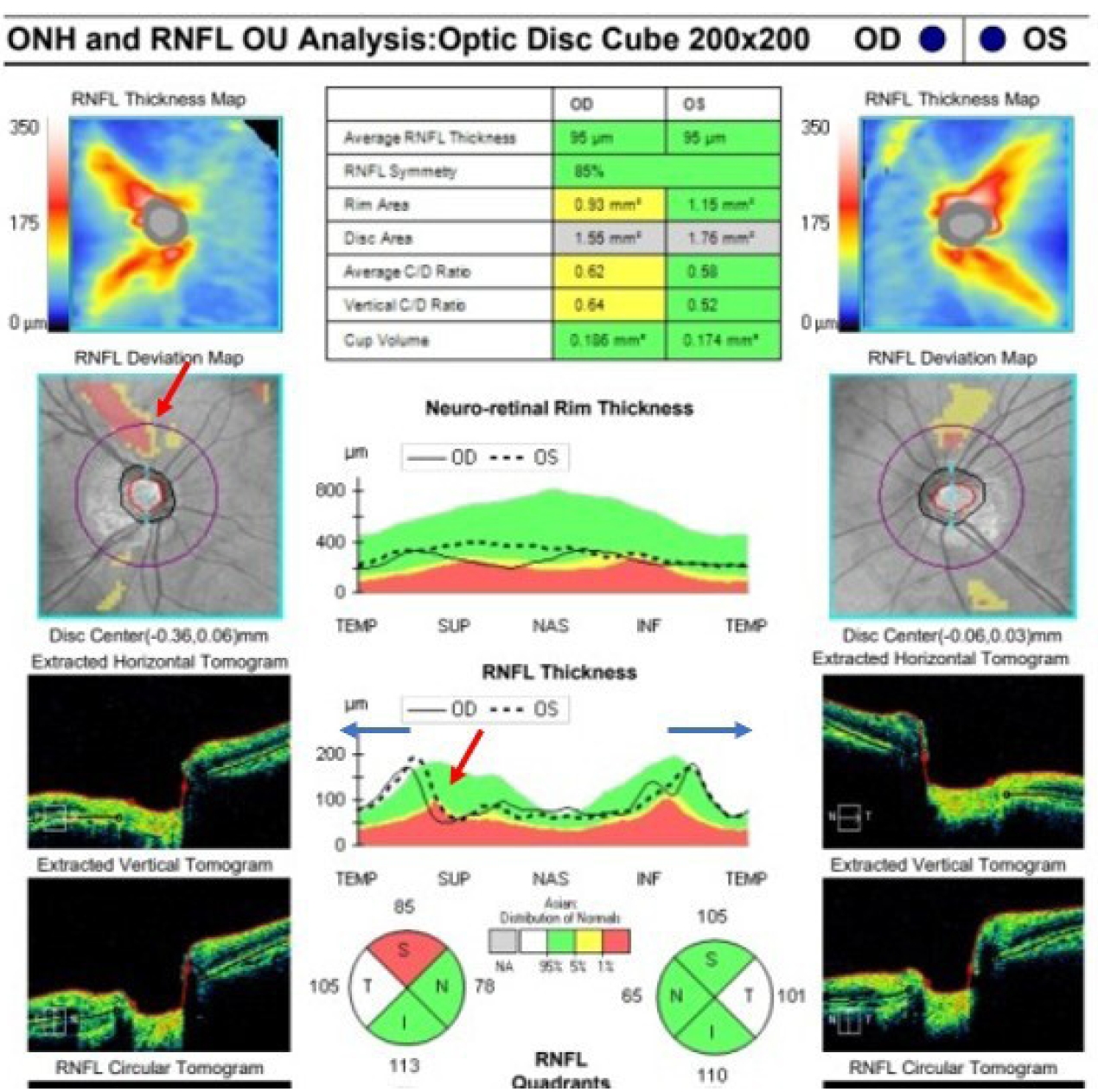
ePub - The global prevalence of refractive surgery for myopia has increased substantially; however, definitive guidance regarding its effects on glaucoma assessment and progression remains limited. Although advances in technology and diagnostic instruments have improved the detection and monitoring of glaucoma in patients undergoing refractive surgery, concerns persist regarding postoperative intraocular pressure (IOP) elevation and the inaccuracy of IOP measurements associated with reduced central corneal thickness. Myopia is a well-established risk factor for primary open-angle glaucoma, and this risk may be further increased by various intraoperative and postoperative factors related to refractive surgery. Therefore, thorough preoperative glaucoma screening, along with systematic postoperative follow-up and evaluation, is essential. This review delineates key considerations before refractive surgery and summarizes important clinical issues in eyes that have undergone refractive procedures. Furthermore, it outlines the pathogenesis, mechanisms, and management strategies for postoperative IOP elevation.
- 3,514 View
- 17 Download

Original Articles
- Comparison of combined torsional and conventional ultrasound mode versus torsional ultrasound mode phacoemulsification in different machines
- Jiyoung Emily Lee, Eun Chul Kim
- Insights Cataract Refract Surg 2026;11(2):40-46. Published online May 21, 2026
- DOI: https://doi.org/10.63375/icrs.25.018
-
Abstract
PDFePub
- Purpose
This study aimed to compare the clinical outcomes of phacoemulsification performed using a combined torsional and conventional ultrasound mode versus torsional ultrasound mode alone in cataract surgery.
Methods
Sixty-five patients who underwent phacoemulsification using combined torsional and conventional ultrasound mode with the Cube alpha system (Nidek Co.) were compared with 300 patients who underwent phacoemulsification using torsional ultrasound mode alone with the Centurion system (Alcon Research Ltd.). The two groups were classified as N3, N4, N5, or N6 according to the Lens Opacities Classification System III. In each subgroup, phacoemulsification time (seconds), cumulative dissipated energy (CDE), balanced salt solution (BSS) use, and postoperative best-corrected visual acuity were analyzed and compared between the combined-mode group and the torsional-only group.
Results
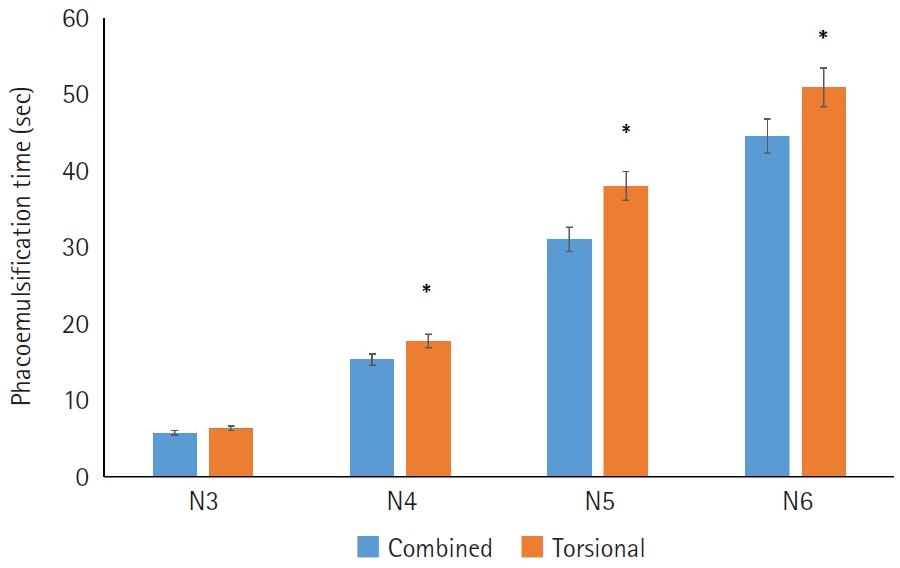
In the N4–N6 subgroups, the torsional-only group had significantly longer phacoemulsification times and higher CDE values than the combined-mode group (P<0.05 for all comparisons). In the N3–N6 subgroups, the total volume of BSS used in the torsional-only group (N3, 30.97±11.05; N4, 48.56±20.06; N5, 68.27±23.06; N6, 125.64±45.67) was significantly greater than that used in the combined-mode group (N3, 23.01±10.27; N4, 39.03±24.16; N5, 42.86±18.24; N6, 54.75±0.75) (P<0.05). There were no statistically significant differences between the groups in postoperative manifest refraction spherical equivalent, corneal endothelial cell loss, or best-corrected visual acuity.
Conclusion
Compared with torsional ultrasound mode alone, the combined torsional and conventional ultrasound mode was more efficient in terms of ultrasound time, CDE, and BSS use. This advantage was more evident with increasing nuclear sclerosis grade.
- 794 View
- 12 Download
- Clinical outcomes of combined phacoemulsification and epiretinal membrane peeling using three advanced intraocular lens platforms
- Chan Hong Min, Jaehyuck Jo, Ho Seok Chung, Dong Yoon Kim, Jin Hyoung Park
- Insights Cataract Refract Surg 2026;11(2):47-55. Published online May 21, 2026
- DOI: https://doi.org/10.63375/icrs.26.001
-
Abstract
PDFePub
- Purpose
This retrospective study evaluated the clinical outcomes of combined phacoemulsification, implantation of 1 of 3 types of advanced intraocular lenses (IOLs) with multifocality, and pars plana vitrectomy with epiretinal membrane (ERM) peeling in patients with cataract and ERM. Outcomes were compared with those in age-matched controls who underwent phacoemulsification with the same IOL alone.
Methods
A total of 70 eyes were included: 35 eyes underwent combined surgery, and 35 served as controls. In each group, 15 eyes received an advanced monofocal IOL (Tecnis Eyhance ICB00), 15 received a hybrid diffractive extended-depth-of-focus (EDoF) IOL (Tecnis Symfony ZXR00), and five received a hybrid refractive EDoF IOL (Precizon Presbyopic NVA).
Results
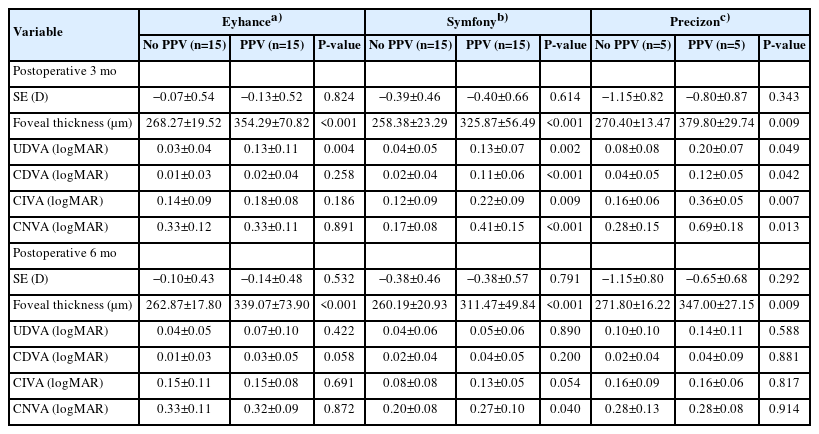
All groups showed significant visual improvement by 6 months postoperatively. Eyes that received hybrid diffractive EDoF IOLs and underwent combined surgery showed significantly worse mean corrected distance visual acuity, uncorrected distance visual acuity, corrected intermediate visual acuity, and corrected near visual acuity at 3 months than control eyes, but these outcomes improved to levels comparable to those of control eyes by 6 months. Eyes that received hybrid refractive EDoF IOLs showed similar early delays; however, interpretation was limited by the small sample size.
Conclusion
Overall, combined surgery was safe and effective, although early visual recovery may be delayed in eyes receiving EDoF IOLs. These findings suggest that advanced monofocal and EDoF IOLs may be considered in selected patients with ERM; however, the results should be interpreted cautiously because of the retrospective design and limited sample size.
- 873 View
- 18 Download
- Effects of extract of Parthenocissus tricuspidata living on pine in a nonclinical model of dry eye disease
- Hyeyoon Goo, Chung-Hun Oh, Kyong Jin Cho
- Insights Cataract Refract Surg 2026;11(2):56-68. Published online June 30, 2026
- DOI: https://doi.org/10.63375/icrs.26.005
-
Abstract
PDF
 Supplementary MaterialePub
 - Purpose
Dry eye disease (DED) is a multifactorial ocular surface disorder characterized by tear film instability, hyperosmolarity, and inflammation. Oxidative stress plays an important role in DED pathogenesis by exacerbating ocular surface damage. Parthenocissus tricuspidata growing on pine (PT) has been reported to have antioxidant and anti-inflammatory properties.
Methods
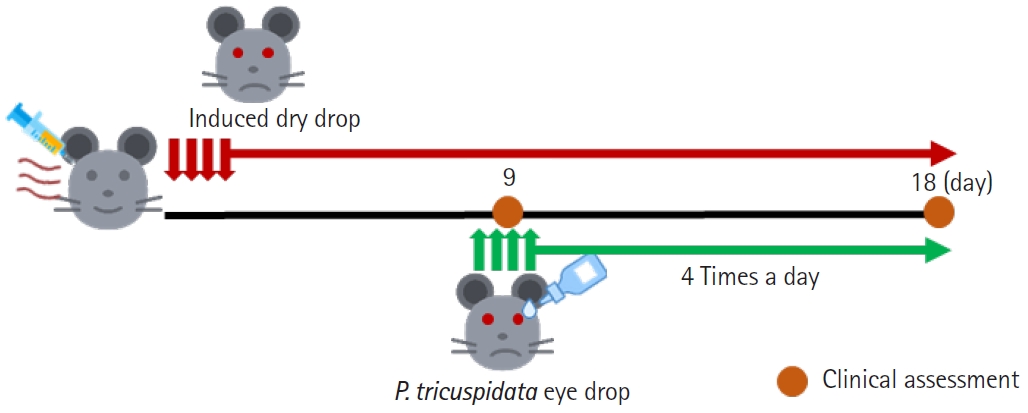
Oxidative stress was induced in human conjunctival epithelial cells (Wong-Kilbourne derivative of Chang conjunctival [WKD] cells) using H2O2, and the antioxidant and protective effects of PT were evaluated. The anti-inflammatory and therapeutic effects of PT were also investigated in a mouse model of DED.
Results
In WKD cells, PT treatment reduced H2O2-induced apoptosis, reactive oxygen species production, and phosphorylation of mitogen-activated protein kinase signaling proteins. Antioxidant enzyme activity, including superoxide dismutase and catalase, increased, whereas malondialdehyde and interleukin-6 levels decreased, indicating reduced oxidative stress and inflammation. In vivo, PT eye drops significantly improved clinical signs of DED, including tear volume and tear film break-up time. Histological analysis and cytokine assays showed reduced expression of pro-inflammatory markers in corneal and conjunctival tissues.
Conclusion
PT extract exerts therapeutic antioxidant and anti-inflammatory effects, highlighting its potential as a treatment for DED.
- 854 View
- 17 Download
 First
First Prev
Prev


