
 KSCRS

Search
- Page Path
- HOME > Search
Original Article
- Effect of lubricant eye drops administered before visual field testing in patients with glaucoma and dry eye
- Jiyoung Emily Lee, Eun Chul Kim
- Insights Cataract Refract Surg 2026;11(3):91-97. Published online October 29, 2026
- DOI: https://doi.org/10.63375/icrs.26.009
-
 Abstract
 PDF
 ePub
- Purpose
This study aimed to evaluate the effect of administering lubricant eye drops before visual field testing in patients with glaucoma and dry eye syndrome.
Methods
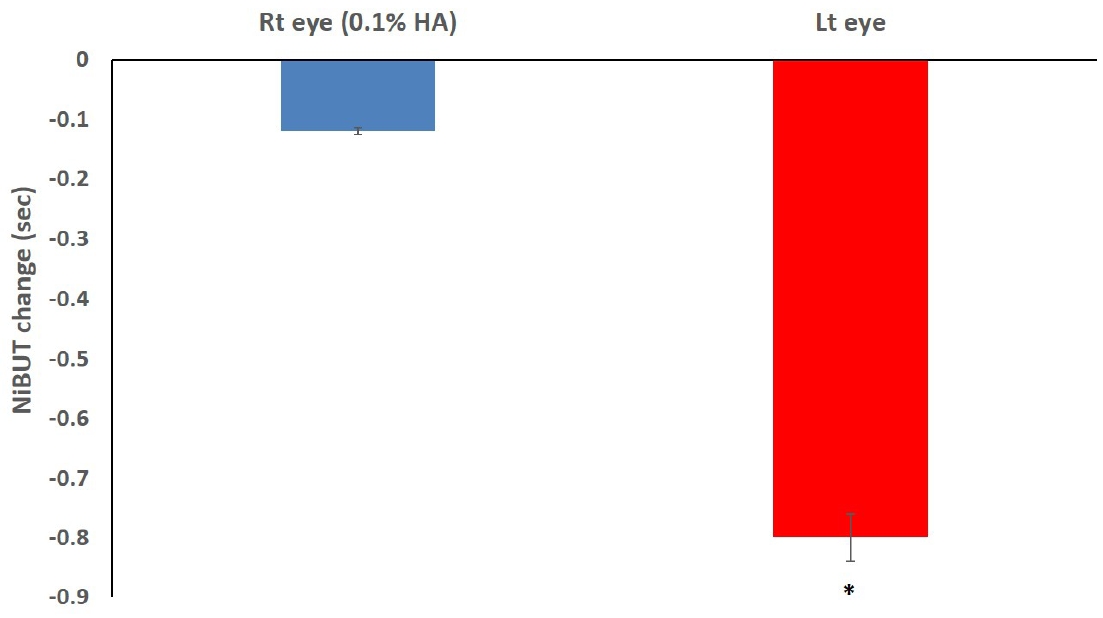
The records of 30 patients (60 eyes) with dry eye syndrome were retrospectively reviewed. Before visual field testing, 0.1% hyaluronic acid eye drops were administered to the right eye, while the left eye received no drops. The efficacy of the lubricant eye drops was assessed by retrospectively comparing tear meniscus height, noninvasive tear film break-up time (NiBUT), and corneal staining scores before and after testing.
Results
Before visual field testing, NiBUT was 5.16±2.19 seconds in the right eye and 5.07±1.98 seconds in the left eye; after testing, it was 5.04±2.36 seconds and 4.27±1.32 seconds, respectively. Tear meniscus height was 0.26±0.11 mm in the right eye and 0.25±0.10 mm in the left eye before testing, decreasing to 0.25±0.11 mm and 0.22±0.10 mm, respectively, afterward. Before testing, corneal staining scores were 1.07±0.74 in the right eye and 1.17±0.86 in the left eye; after testing, they were 1.33±0.76 and 1.90±0.95, respectively. The decreases in NiBUT and tear meniscus height from before to after testing were greater in the left eye than in the right eye, and corneal staining increased significantly (P<0.05). Fixation loss, false-positive, and false-negative rates during visual field testing were all significantly higher in the left eye than in the right eye (P<0.05).
Conclusion
Visual field testing requires patients to keep their eyes open and maintain focus for an extended period, which can exacerbate symptoms in patients with dry eye syndrome and potentially compromise test accuracy. Administering lubricant eye drops before testing, following consultation with an ophthalmologist, is thought to alleviate dry eye symptoms and improve test accuracy.
- 241 View
- 2 Download

Review Articles
- Premium intraocular lens selection in glaucoma: an approach based on visual function and disease characteristics
- Yeoun Sook Chun
- Insights Cataract Refract Surg 2026;11(3):69-82. Published online October 29, 2026
- DOI: https://doi.org/10.63375/icrs.26.008
-
Abstract
PDFePub
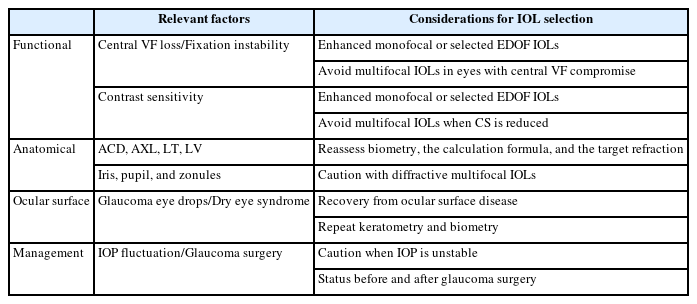
- The increasing global incidence of cataracts and glaucoma, together with rising patient expectations, is leading to a steady increase in premium intraocular lens (IOL) implantation. However, concerns remain about the use of premium IOLs in eyes with glaucoma. Selecting an IOL for a patient with glaucoma requires comprehensive consideration of central visual field defects, contrast sensitivity, fixation stability, anterior segment anatomy, ocular surface disease, intraocular pressure control, topical medication use, previous or anticipated glaucoma surgery, and the lifelong risk of glaucoma progression. For glaucoma suspects and patients with ocular hypertension or early, stable open-angle glaucoma, enhanced monofocal IOLs may help improve intermediate vision while maintaining distance visual acuity and preserving contrast sensitivity. Extended depth-of-focus IOLs may also be considered for selected patients with glaucoma and preserved central visual function. Toric IOLs have generally yielded favorable outcomes, but their use should be considered only when astigmatism is regular and reproducible and capsular–zonular support is stable. Multifocal IOL implantation is generally not recommended for patients with glaucoma and visual field defects; it should be considered only in highly selected glaucoma suspects or patients with very early, stable glaucoma, after careful functional assessment and with long-term monitoring. This review aims to systematically summarize considerations for individualized IOL selection and preoperative counseling in patients with glaucoma, integrating functional vulnerability, ocular anatomy, refractive variability, glaucoma subtypes, and the risk of disease progression with the optical characteristics of each IOL design.
- 459 View
- 9 Download
- Glaucoma evaluation and management in refractive surgery candidates: a review
- Yeoun Sook Chun
- Insights Cataract Refract Surg 2026;11(2):27-39. Published online June 18, 2026
- DOI: https://doi.org/10.63375/icrs.26.002
-
Abstract
PDFePub
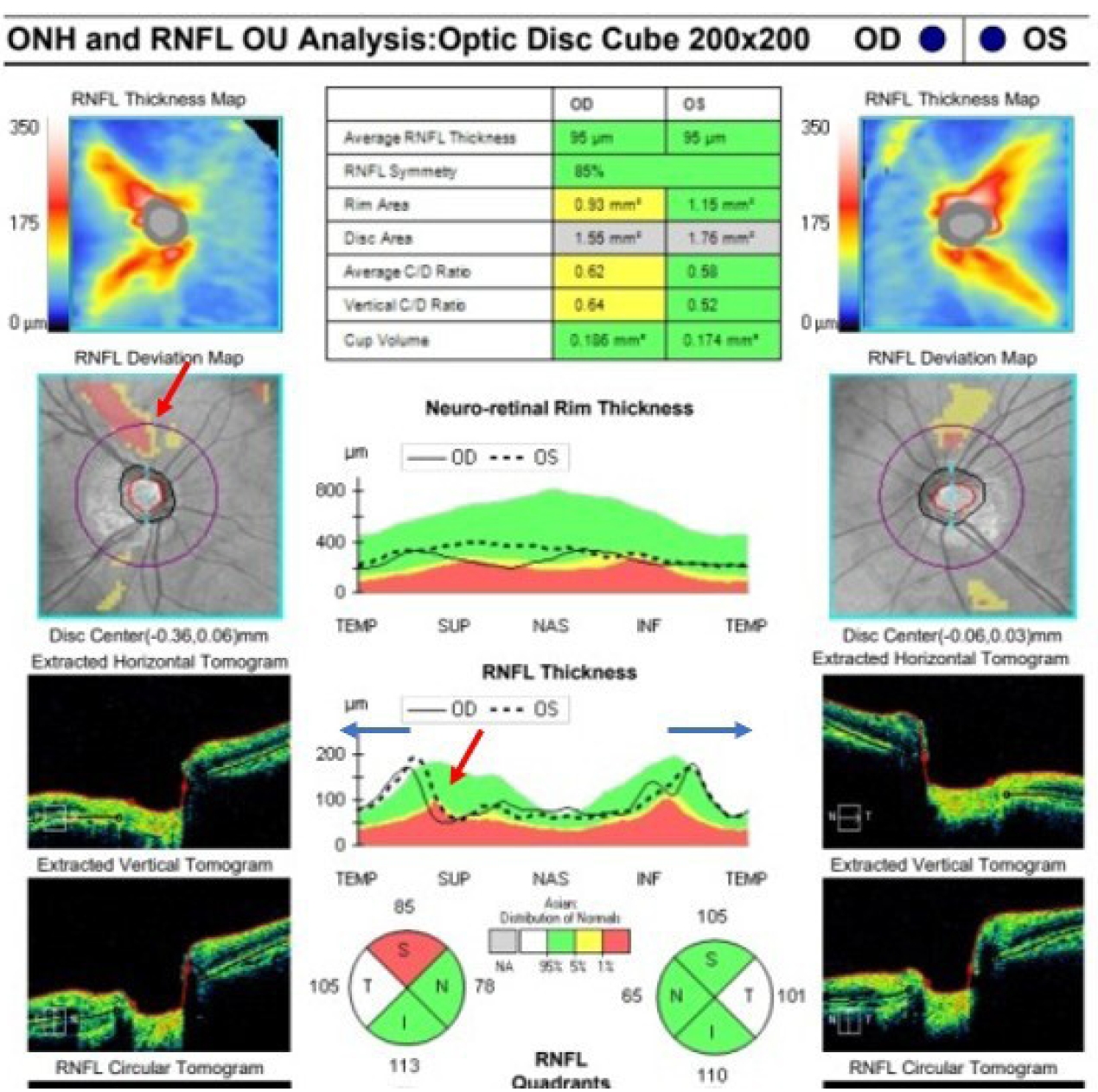
- The global prevalence of refractive surgery for myopia has increased substantially; however, definitive guidance regarding its effects on glaucoma assessment and progression remains limited. Although advances in technology and diagnostic instruments have improved the detection and monitoring of glaucoma in patients undergoing refractive surgery, concerns persist regarding postoperative intraocular pressure (IOP) elevation and the inaccuracy of IOP measurements associated with reduced central corneal thickness. Myopia is a well-established risk factor for primary open-angle glaucoma, and this risk may be further increased by various intraoperative and postoperative factors related to refractive surgery. Therefore, thorough preoperative glaucoma screening, along with systematic postoperative follow-up and evaluation, is essential. This review delineates key considerations before refractive surgery and summarizes important clinical issues in eyes that have undergone refractive procedures. Furthermore, it outlines the pathogenesis, mechanisms, and management strategies for postoperative IOP elevation.
- 3,860 View
- 20 Download
- Trabecular microbypass using iStent combined with cataract surgery
- Yeoun Sook Chun
- Insights Cataract Refract Surg 2025;10(2):42-51. Published online June 30, 2025
- DOI: https://doi.org/10.63375/icrs.25.007
-
Abstract
PDFePub
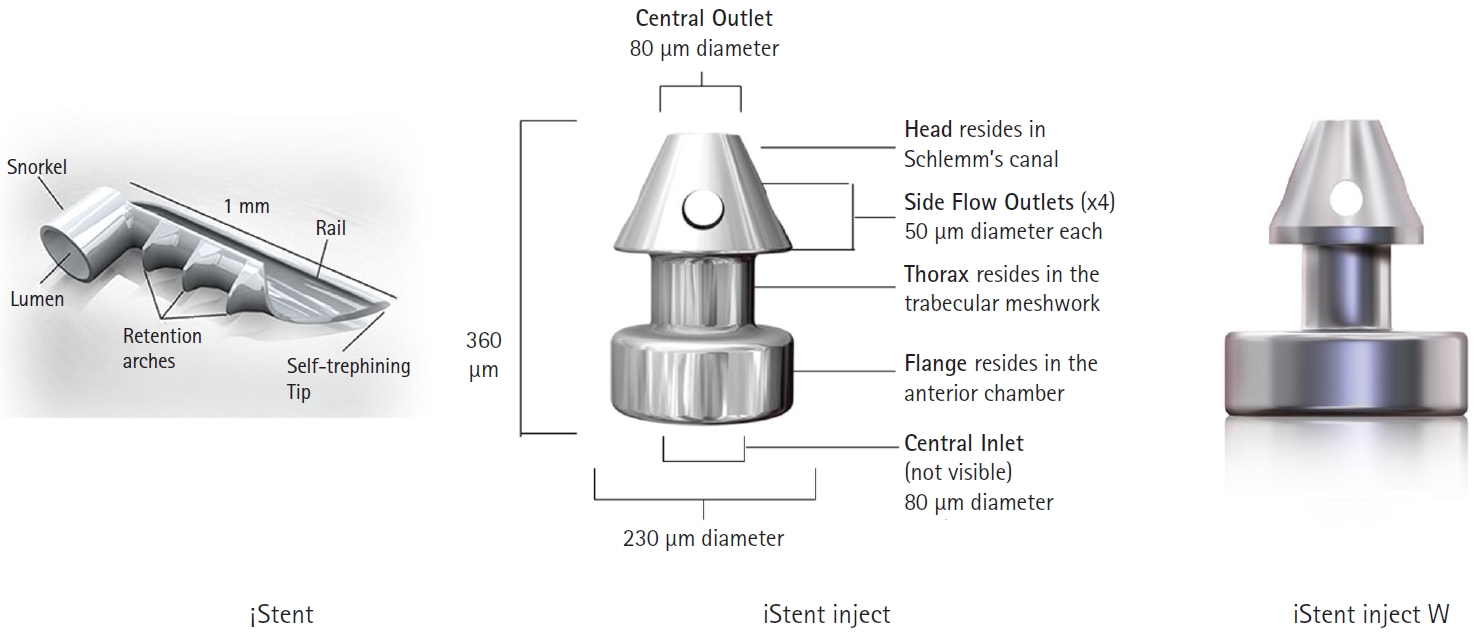
- Minimally invasive glaucoma surgery has revolutionized conventional glaucoma treatment due to its simple procedures, rapid recovery, and few complications. iStent, a trabecular microbypass that can be implanted via combined cataract surgery, has the advantage of lowering intraocular pressure (IOP) independent of bleb formation. Furthermore, it is straightforward to implement and does not involve a substantial burden. iStent has a synergetic effect with phacoemulsification. Combining iStent with phacoemulsification yielded a greater reduction of IOP and glaucoma eyedrops, as well as higher rates of visual field change, than when either modality was used in isolation. iStent has emerged as a new treatment option for patients with mild to moderate glaucoma. This review aims to improve readers’ understanding of iStent by summarizing the surgical techniques needed to correctly insert it for optimal outcomes and discussing problem-solving in the context of patient care.
- 1,971 View
- 14 Download
 First
 Prev



