
 KSCRS

Search
- Page Path
- HOME > Search
Review Article
- Premium intraocular lens selection in glaucoma: an approach based on visual function and disease characteristics
- Yeoun Sook Chun
- Insights Cataract Refract Surg 2026;11(3):69-82. Published online October 29, 2026
- DOI: https://doi.org/10.63375/icrs.26.008
-
 Abstract
 PDF
 ePub
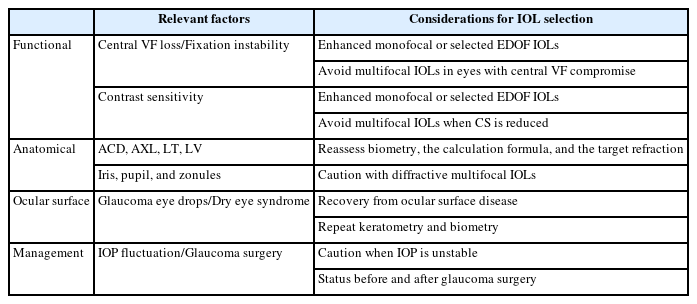
- The increasing global incidence of cataracts and glaucoma, together with rising patient expectations, is leading to a steady increase in premium intraocular lens (IOL) implantation. However, concerns remain about the use of premium IOLs in eyes with glaucoma. Selecting an IOL for a patient with glaucoma requires comprehensive consideration of central visual field defects, contrast sensitivity, fixation stability, anterior segment anatomy, ocular surface disease, intraocular pressure control, topical medication use, previous or anticipated glaucoma surgery, and the lifelong risk of glaucoma progression. For glaucoma suspects and patients with ocular hypertension or early, stable open-angle glaucoma, enhanced monofocal IOLs may help improve intermediate vision while maintaining distance visual acuity and preserving contrast sensitivity. Extended depth-of-focus IOLs may also be considered for selected patients with glaucoma and preserved central visual function. Toric IOLs have generally yielded favorable outcomes, but their use should be considered only when astigmatism is regular and reproducible and capsular–zonular support is stable. Multifocal IOL implantation is generally not recommended for patients with glaucoma and visual field defects; it should be considered only in highly selected glaucoma suspects or patients with very early, stable glaucoma, after careful functional assessment and with long-term monitoring. This review aims to systematically summarize considerations for individualized IOL selection and preoperative counseling in patients with glaucoma, integrating functional vulnerability, ocular anatomy, refractive variability, glaucoma subtypes, and the risk of disease progression with the optical characteristics of each IOL design.
- 459 View
- 9 Download

Original Article
- Comparison of toric intraocular lenses and limbal relaxing incision in extended-depth-of-focus intraocular lens implantation
- Jiyoung Emily Lee, Eun Chul Kim
- Insights Cataract Refract Surg 2026;11(3):83-90. Published online September 23, 2026
- DOI: https://doi.org/10.63375/icrs.26.003
-
Abstract
PDFePub
- Purpose
This study aimed to compare visual and refractive outcomes after toric intraocular lens (IOL) implantation and limbal relaxing incision (LRI) in eyes receiving extended-depth-of-focus (EDOF) IOLs.
Methods
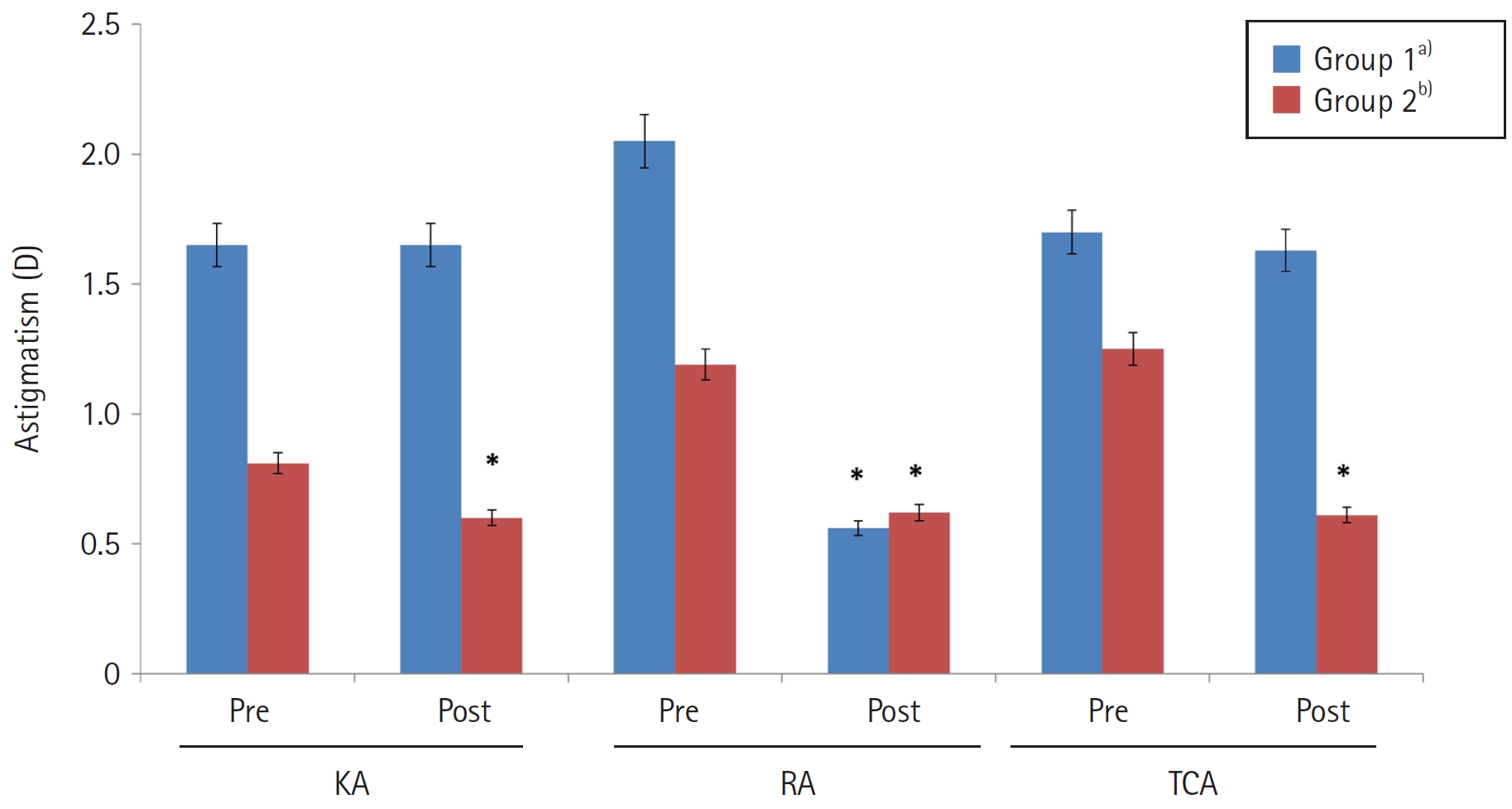
Clinical outcomes were compared between 60 patients who underwent EDOF toric IOL implantation and 60 patients who underwent EDOF IOL implantation combined with LRI. A toric IOL was implanted when corneal astigmatism exceeded 1.0 diopters (D) (group 1), whereas LRI was performed when corneal astigmatism was 1.0 D or less (group 2). Corneal astigmatism, refractive astigmatism, refraction, uncorrected visual acuity, and corrected visual acuity (logMAR) were analyzed in each group before surgery and 3 months postoperatively.
Results
Corneal and total corneal astigmatism did not differ significantly between preoperative and postoperative measurements in group 1 (P>0.05). In group 2, postoperative corneal and total corneal astigmatism (0.60±0.13 and 0.61±0.28 D, respectively) were significantly lower than the corresponding preoperative values (0.81±0.36 and 1.25±0.32 D, respectively; P<0.05). Refractive astigmatism decreased significantly in both group 1 and group 2, from 2.05±0.64 and 1.18±0.41 D preoperatively to 0.56±0.32 and 0.62±0.26 D at 3 months postoperatively, respectively; however, the magnitude of reduction was significantly greater in group 1 than in group 2 (P<0.05). Postoperative refractive astigmatism did not differ significantly between the two groups (P>0.05). In both groups, uncorrected and corrected visual acuity improved significantly after surgery (P<0.05), with no significant between-group difference (P>0.05).
Conclusion
Combining an EDOF IOL with LRI may be effective for mild astigmatism, whereas selecting a toric EDOF IOL may better support visual improvement in patients with moderate to severe astigmatism.
- 362 View
- 7 Download
Review Article
- Presbyopia-correcting intraocular lens options in myopic eyes undergoing cataract surgery
- Sang Beom Han
- Insights Cataract Refract Surg 2026;11(1):1-8. Published online February 26, 2026
- DOI: https://doi.org/10.63375/icrs.25.016
-
Abstract
PDFePub
- With ongoing advancements in surgical techniques and intraocular lens (IOLs) technologies, cataract surgery is increasingly recognized as a form of refractive procedure aimed at enhancing overall visual performance rather than being viewed solely as lens extraction. In parallel with this shift, a growing number of aging individuals with myopia are actively seeking spectacle independence following cataract surgery. The selection of IOLs for presbyopia correction in patients with myopia presents distinct clinical and refractive challenges, necessitating careful preoperative evaluation and individualized surgical planning. In this review, the author summarizes current evidence regarding the use of various IOLs, including monofocal, enhanced monofocal, extended depth-of-focus, and multifocal IOLs, for presbyopia correction in myopic patients and discusses key considerations involved in selecting the most appropriate IOL for this specific population.
- 1,354 View
- 14 Download
Original Article
- Results of multifocal intraocular lens implantation in patients who underwent corneal refractive surgery
- Eun Chul Kim
- Insights Cataract Refract Surg 2025;10(3):76-82. Published online October 31, 2025
- DOI: https://doi.org/10.63375/icrs.25.011
-
Abstract
PDFePub
- Purpose
The aim of this study was to evaluate the clinical results of multifocal intraocular lenses in patients who underwent corneal refractive surgery.
Methods
Thirty eyes (16 patients; Synergy: ZFR00V) were retrospectively enrolled. Uncorrected and corrected near visual acuity (UNVA, CNVA), intermediate visual acuity (UIVA, CIVA), and distant visual acuity (UDVA, CDVA), manifest refraction spherical equivalent (MRSE), and satisfaction score were assessed before and after surgery.
Results
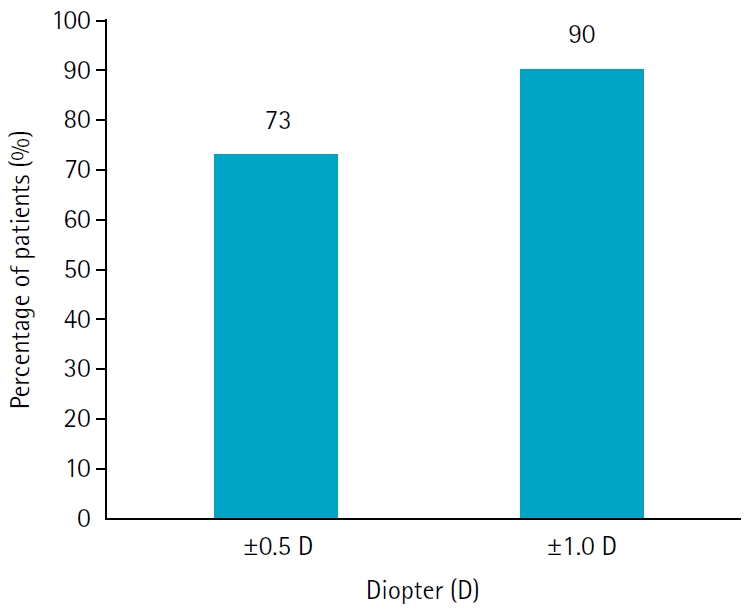
The postoperative UDVA, UIVA, UNVA, and MRSE of the three groups exhibited improvements compared to the preoperative data (P<0.05). The error between the postoperative refraction and the intraocular lens calculation was smaller with the Barrett True K formula than with the Haigis-L formula (P<0.05). The defocus curve at 0 diopter (D) increased, from –1 to –1.5 D, and from –2.5 to –4.0 D, indicating improved vision at distant, intermediate, and near distances. Distance satisfaction (1.47±0.63), near satisfaction (1.25±0.71), and overall satisfaction (1.36±0.42) were good, but light scattering and halo satisfaction (1.97±0.85) yielded a poor result.
Conclusion
In patients with cataracts who underwent corneal refractive surgery, multifocal intraocular lens implantation resulted in excellent uncorrected visual acuity at distant, intermediate, and near distances. However, careful consideration should be given to patient selection due to the incidence of side effects such as glare and halos.
- 1,563 View
- 19 Download
Review Article
- Selection of an optimal intraocular lens according to the stage of epiretinal membrane
- Sang Beom Han
- Insights Cataract Refract Surg 2025;10(1):7-12. Published online February 28, 2025
- DOI: https://doi.org/10.63375/icrs.25.003
-
Abstract
PDFePub
- Epiretinal membrane (ERM), one of the most common retinal diseases, can cause various degrees of visual disturbance, reduced contrast sensitivity, and metamorphopsia. ERM is not infrequently encountered during preoperative evaluations for cataract surgery, and selecting an appropriate intraocular lens (IOL) according to the location and stage of ERM is necessary in order to improve visual outcomes and patients’ satisfaction. This review summarizes the application of various IOLs—such as multifocal, extended depth of focus, and enhanced monofocal IOLs—in eyes with ERM, and discusses the selection of an appropriate IOL.
-
Citations
Citations to this article as recorded by
- Presbyopia-correcting intraocular lens options in myopic eyes undergoing cataract surgery
Sang Beom Han
Insights in Cataract and Refractive Surgery.2026; 11(1): 1. CrossRef
- Presbyopia-correcting intraocular lens options in myopic eyes undergoing cataract surgery
- 3,291 View
- 23 Download
- 1 Crossref
 First
 Prev



