
 KSCRS
KSCRS
Search
- Page Path
- HOME > Search
Case Report
- Large incisional tear caused by abrupt Bell’s phenomenon during pocket irrigation in femtosecond laser-assisted small incision lenticule extraction
- Sang Beom Han
- Insights Cataract Refract Surg 2026;11(1):23-25. Published online February 26, 2026
- DOI: https://doi.org/10.63375/icrs.25.015

-
 Abstract
 PDF
PDF ePub
ePub - Purpose
This study reports a case of a large incisional tear caused by abrupt Bell’s phenomenon during pocket irrigation in femtosecond laser-assisted small incision lenticule extraction (SMILE).
Case
summary: A 28-year-old male patient underwent SMILE surgery. During pocket irrigation of the right eye, Bell’s phenomenon suddenly occurred, resulting in a large inferior arcuate extension of the incision that reached the inferior cap margin. After confirming wound integrity and the absence of additional tissue damage, a bandage contact lens was applied. On postoperative day 7, the incision was self-sealed with intact wound integrity. Three months postoperatively, uncorrected distance visual acuity was 20/20 in both eyes. The right cornea remained stable, although a faint residual scar was observed at the site of the incisional tear.
Conclusion
Abrupt eye movements during pocket irrigation in SMILE can cause large incisional tears. Surgeons should exercise heightened vigilance during irrigation, particularly in anxious or uncooperative patients, to prevent such complications.
- 847 View
- 7 Download

Original Article
- The effect of 2% rebamipide ophthalmic solution on early dry eye after SMILE surgery: a retrospective study
- Jin Hyoung Kim, Mu Yan Kim, Young A Kwon, Sung Wook Park, Sung Won Byun, Seong Woo Lee, Sung Hyup Lim
- Insights Cataract Refract Surg 2025;10(3):91-102. Published online October 31, 2025
- DOI: https://doi.org/10.63375/icrs.25.013
-
Abstract
PDFePub
- Purpose
The aim of this study was to investigate the effect of rebamipide 2% ophthalmic solution on early dry eye following small incision lenticule extraction (SMILE) surgery by analyzing dry eye indicators before and after the procedure.
Methods
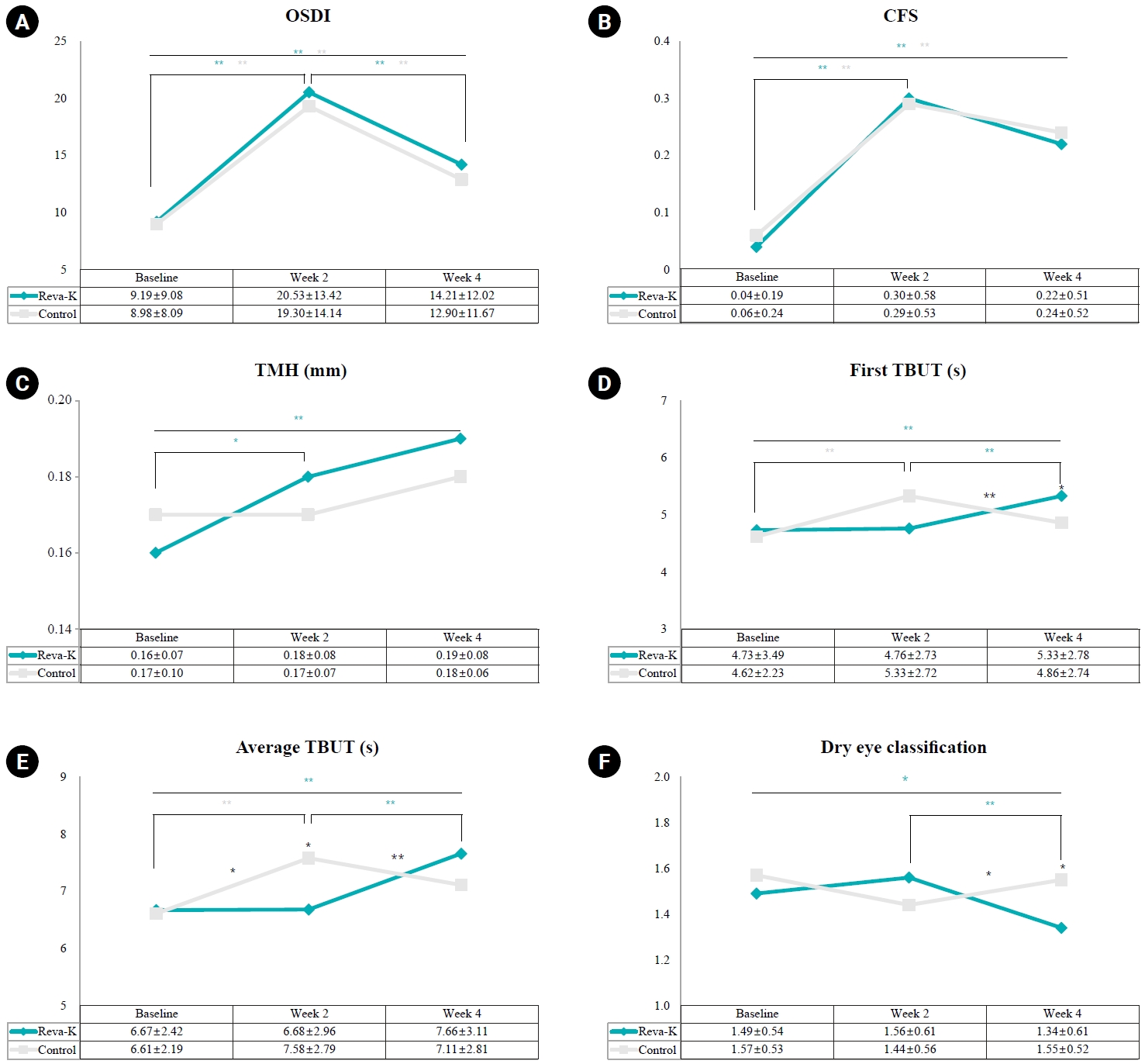
In this retrospective study, an initial sample of 372 SMILE surgery patients were divided into a rebamipide group (artificial tears and 2% rebamipide) and a control group (artificial tears only). Changes in dry eye indicators, including the Ocular Surface Disease Index (OSDI), corneal fluorescein staining (CFS) score, tear meniscus height (TMH), tear break-up time (TBUT), and dry eye classification, were analyzed at 2 and 4 weeks postoperatively in comparison with the preoperative baseline.
Results
In total, 250 patients (250 eyes) were selected: 135 in the rebamipide group and 115 in the control group. Preoperative characteristics such as gender, age, spherical equivalent refraction, ablation depth, and optical zone size showed no significant differences between the two groups. Both groups demonstrated a significant increase in OSDI and CFS scores at 2 weeks postoperatively, followed by a decrease at 4 weeks, with no significant differences between groups. TMH increased significantly in the rebamipide group at 2 and 4 weeks (P=0.043, P=0.004), but showed no significant change in control group or intergroup difference. No significant difference was found in the first TBUT between the two groups at any time point, but the average TBUT significantly and rapidly increased from 2 to 4 weeks postoperatively in the rebamipide group (P=0.001). The dry eye classification was significantly lower in the rebamipide group at 4 weeks postoperatively (P=0.014).
Conclusion
The use of rebamipide 2% ophthalmic solution immediately after SMILE surgery is expected to be helpful in treating early postoperative dry eye, as it increased TMH and TBUT starting from 2 weeks postoperatively.
- 3,320 View
- 14 Download
Case Report
- Diffuse lamellar keratitis after small incision lenticule extraction: presumably related to meibomian gland dysfunction
- Sang Beom Han
- Insights Cataract Refract Surg 2025;10(2):61-64. Published online June 30, 2025
- DOI: https://doi.org/10.63375/icrs.25.008
-
Abstract
PDFePub
- Purpose
This report presents a case of diffuse lamellar keratitis (DLK) after femtosecond laser-assisted small incision lenticule extraction (SMILE). The case was presumably associated with meibomian gland dysfunction (MGD).
Case
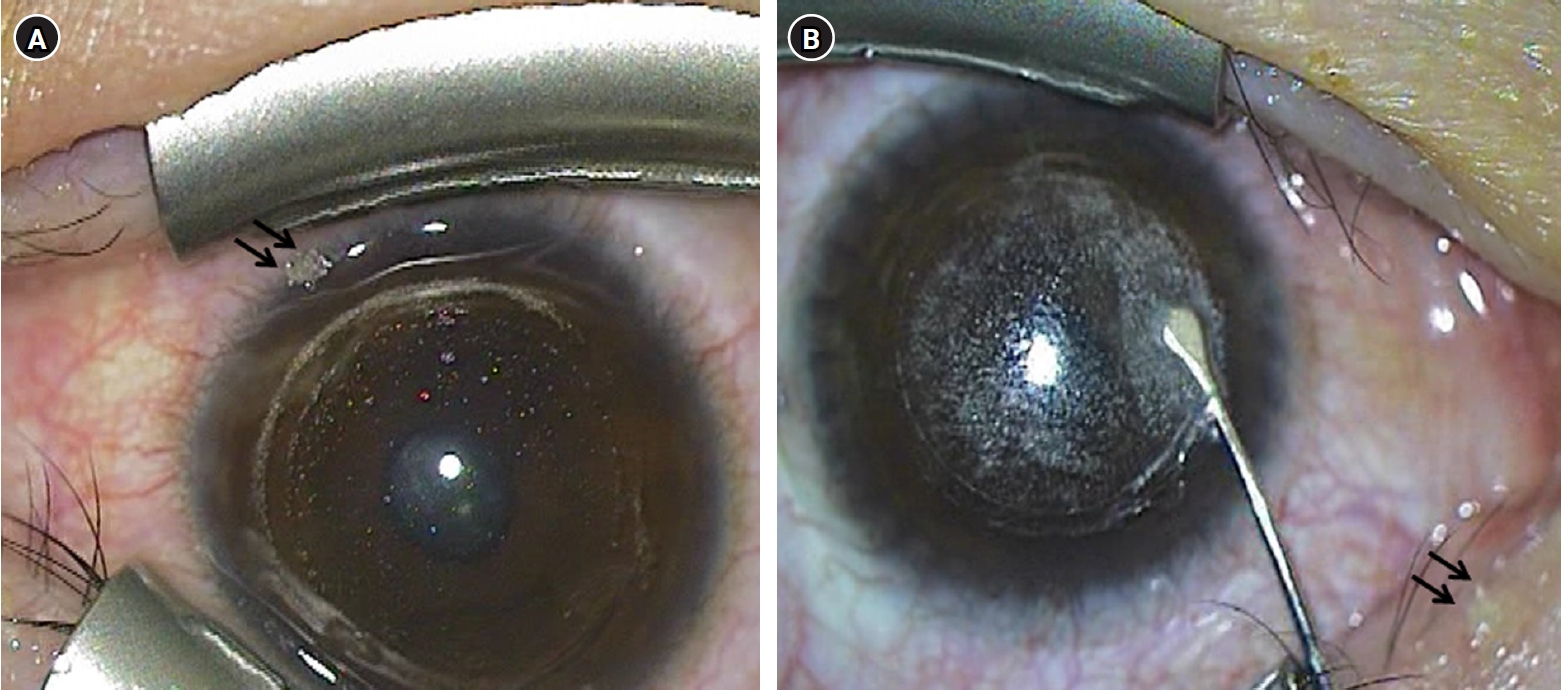
summary: A 25-year-old male patient underwent SMILE surgery. Preoperative examination revealed MGD in both eyes. Despite vigorous cleaning of the eyelid margin and irrigation of the ocular surface, meibomian gland secretion floating on the ocular surface was observed after the lenticule extraction in the right eye. At 2 days postoperatively, stage I DLK was detected. After aggressive topical steroid treatment, the DLK completely resolved without any sequalae.
Conclusion
DLK can occur in association with MGD. Attention should be paid when performing SMILE in eyes with MGD.
- 4,462 View
- 34 Download
 First
First Prev
Prev


